Free Load-Bearing Wall Calculator (Meets IRC 2021 & NDS 2018)
As an Amazon Associate, I earn from qualifying purchases.
My Load-Bearing Wall Calculator helps U.S. homeowners, DIYers, and small contractors to find the correct stud size for walls in garages, sheds, barns, and other small buildings.
This Load-Bearing Wall Calculator is based on the International Residential Code (IRC 2021) and the National Design Specification for Wood Construction (NDS 2018).
Quite often, “supported load (plf)” is difficult to estimate. This Load-Bearing Wall Calculator makes it easy by using a pre-loaded drop-down menu. You can, of course, choose to enter it manually too for more accurate results.
For unusual loads, large openings, or walls taller than 12 feet, consult a licensed engineer.

 Includes Cp height factor & exterior adjustment
When to consult an engineer
- Wall height > 12 ft
- Large openings or heavy beams
- Seismic or high wind areas
- If status = Does Not Meet
Quick explanation
The tool uses simplified NDS axial values with height adjustment (Cp). For planning only.
FAQs
What does “plf” mean?
Pounds per linear foot — load distributed along wall length.
Why choose 2×6 over 2×4?
2×6 studs have higher capacity and are required if load per stud exceeds 2×4 limits.
Is this code-compliant?
It follows conservative IRC/NDS guidance. Always verify with local code and engineer.
What Is a Load-Bearing Wall Calculator?
Please check out my Stud Wall Load Capacity: 7 Fascinating Things You Need To Know! for a clearer understanding of the topic.
A load-bearing wall calculator is a planning tool that helps you figure out the right stud size for walls that carry structural weight.
Unlike non-load-bearing walls (which act as simple partitions), load-bearing walls transfer the weight of the roof, floors, and sometimes additional loads down to the foundation.
The calculator uses your input, such as wall height, supported load in pounds per linear foot (plf), and type of lumber, to estimate whether standard 2×4 studs will work, or if 2×6 studs (or larger) are needed.
This matters because:
- Too small: Studs may bow, crack drywall, or fail under pressure.
- Too large: You may overspend on materials without any added benefit.
By applying engineering standards (IRC and NDS), the calculator translates technical requirements into a clear, DIY-friendly result.
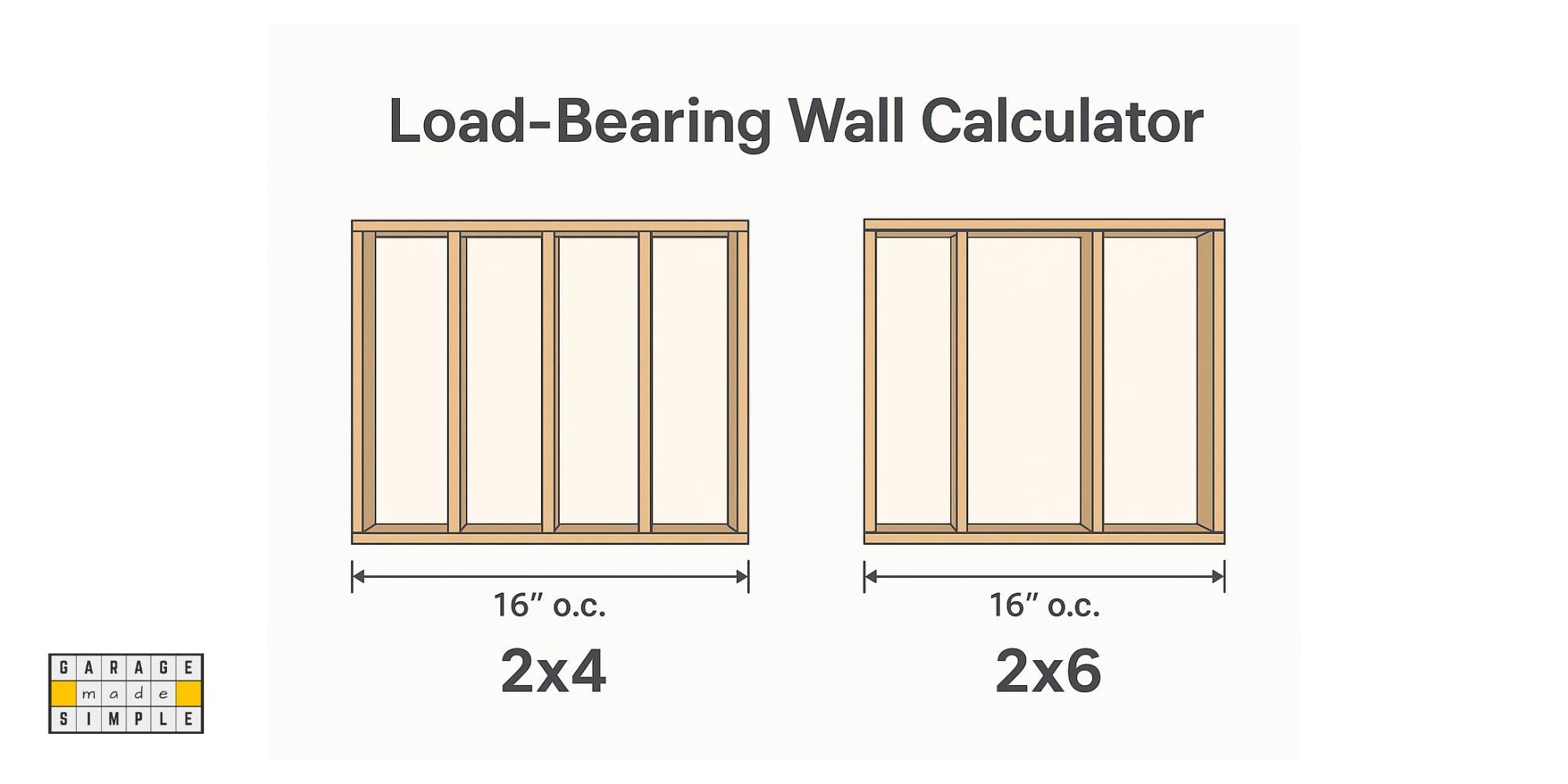
When to Use 2×4 vs 2×6 Studs
One of the most common questions in wall framing is whether a wall can be built with 2×4 studs or if 2×6 studs are required. Here’s a quick breakdown:
- 2×4 Studs
- Suitable for short, interior partitions that don’t carry major loads.
- Work for small sheds or light structures under standard conditions.
- Limited in height and load capacity.
- 2×6 Studs
- Allow taller walls (up to the 12 ft IRC limit under many load conditions).
- Provide more room for insulation (required to meet energy codes in cold zones).
- Offer higher axial load capacity, making them safer for heavier structures.
Best Practices in Stud Wall Framing
Even with a calculator, good framing practices make the difference between a safe, durable wall and one that fails prematurely. Here are a few guidelines:
- Follow IRC 2021 standards: Always verify spacing, wall heights, and lumber requirements.
- Use the right spacing: 16″ on center is standard. Only use 24″ on center if your loads and code allow.
- Choose quality lumber: Avoid warped, twisted, or heavily knotted studs, as they weaken capacity.
- Check for grade stamps: Make sure lumber is properly graded (No. 2 or better).
- Brace walls correctly: Proper sheathing and bracing are essential for stability, especially in exterior walls.
- Mind moisture: Store lumber flat and dry before framing to avoid shrinkage and warping after installation.
Limitations of the Load-Bearing Wall Calculator
This calculator is a planning tool only. It’s not a replacement for an engineered design. Keep these limitations in mind:
- Only valid for walls 12 ft or shorter.
- Doesn’t account for large openings like garage doors or windows.
- Not designed for seismic zones, hurricane areas, or heavy snow regions.
- Doesn’t cover specialty loads such as heavy equipment or mezzanines above.
- If the calculator shows “Does Not Meet”, that means the chosen stud size won’t safely carry the load under the given conditions. Check with a larger stud size or get an engineer to review.
When to Consult a Structural Engineer
While DIYers and small contractors can use this calculator to plan standard projects, some situations demand professional expertise. Consult a licensed engineer if:
- Wall height exceeds 12 feet.
- Your structure has large door or window openings.
- You’re in a seismic or high-wind zone.
- Roof loads include heavy snow, storage, or equipment.
- You’re framing a barn, workshop, or custom structure with unusual spans.
An engineer can apply advanced load combinations, wind/snow maps, and local building codes to ensure your wall design is safe and code-compliant.
Quick Engineering Note: Cp & Axial Values
The calculator uses NDS axial values, which define the vertical load a stud can safely support. These values are adjusted by:
- Cp (Column Stability Factor): Accounts for wall height. The taller the stud, the lower its load capacity.
- Wood species & grade: Douglas Fir-Larch generally carries more load than Spruce-Pine-Fir, for example.
- Exterior adjustment (20% reduction): Because exterior studs face weather exposure, their design capacity is reduced for safety.
This math happens behind the scenes, so users see a simple result. However, knowing the basics explains why stud size changes with height, load, and species.
Conclusion
A Load-Bearing Wall Calculator takes the guesswork out of stud sizing, helping DIYers and contractors frame walls that are both safe and cost-effective.
By entering a few project details, you’ll quickly know if 2x4s will work or if 2×6 studs are required.
That said, the calculator is only a planning tool. It doesn’t replace a structural engineer. For tall walls, unusual loads, or high-risk environments, always seek professional guidance.